


Airbnb Pricing Algorithm: How to Earn Visibility and Maximize Revenue
Quick Answer
Airbnb's pricing algorithm prioritizes listings based on trust signals and revenue potential, using a 60-day performance lookback window. Strategic pricing can increase revenue by 31% in 90 days by optimizing conversion rates, market-relative occupancy (MPI), and forward booking velocity. The algorithm treats search results like prime real estate, with 80% of bookings going to the top 20% of listings.
Key Data Points
31% revenue increase over the first 90 days on new takeovers
Source: Author's portfolio data
100+ listings managed
Source: Author's experience
4+ years of revenue management experience
Source: Author credentials
80% of bookings go to the top 20% of listings
Source: Market analysis
4.8+ stars across 20+ reviews for trust threshold
Source: Platform observation
60-day lookback window for performance evaluation
Source: Algorithm analysis
Pricing on Airbnb is not just what you charge per night — it is how you communicate value to a marketplace algorithm that decides whether your listing deserves attention. After 4+ years of revenue management across 100+ listings, with an average 31% revenue increase over the first 90 days on new takeovers, this framework explains how Airbnb's search algorithm evaluates your listing and why pricing is the biggest lever most hosts are not using strategically.
This is a thought framework, not gospel. It is based on extensive observation, testing, and conversations with owners, operators, and revenue management professionals. If you take nothing else from this article, take this: pricing is how you signal value to a marketplace algorithm that is deciding whether you deserve attention. And Airbnb is absolutely deciding that — every day.
Why Airbnb Is a Marketplace, Not Your Partner
Airbnb's job is not to help hosts. Airbnb's job is to maximize Airbnb's revenue while maintaining guest trust so the marketplace does not collapse. When Airbnb decides what shows up on page one, it is not random, fair, or based on who deserves it. It is a ranking problem.
Airbnb looks at every search result slot like a real estate developer looks at land. Each slot has value. Showing your listing instead of someone else's listing has an opportunity cost — because that is what it is. The platform constantly asks two questions: if we give this listing visibility, does it make us money? Does it protect trust with guests?
That is the game. Understanding this changes how you approach every pricing decision you make.
How Airbnb Treats Page One Like Prime Real Estate
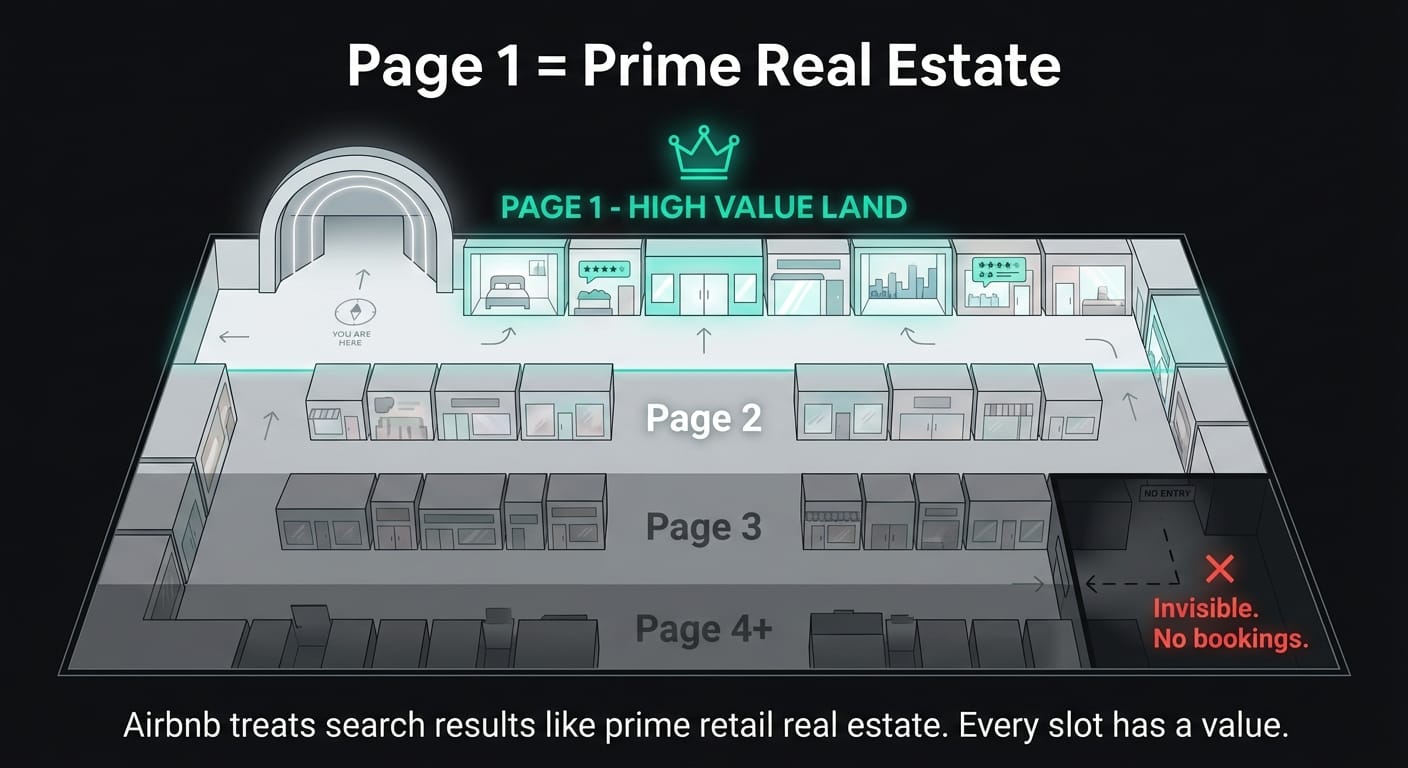
Imagine Airbnb's search results are a shopping mall. Page one is the storefronts right by the entrance. If Airbnb puts a dead store in that spot, the mall makes less money. Airbnb does not want dead stores.
Airbnb treats page one like prime land with monetization potential. Every listing shown there needs to justify why it deserves that position. If Airbnb shows your listing in a high-visibility slot and you do not convert, Airbnb lost money because it wasted a high-value position on something that did not produce a booking.
This is why opportunity cost is the key concept. Every time Airbnb tests your listing with visibility, it is making an investment decision. Your job is to make that investment pay off through bookings.
How Trust and Revenue Drive the Airbnb Algorithm
Airbnb's ranking priorities break into two categories that determine where your listing appears in search results.
Long-Term Trust: Reviews and Legitimacy
Airbnb has doubled down on being a trusted platform — customer support, legitimacy, safety, all of it. In practice, your reviews are the easiest public proxy for trust. If your reviews are strong (4.8+ stars across 20+ reviews), the trust side is mostly handled. According to research on Airbnb ratings, listings with consistent 5-star reviews see measurably higher search placement.
Short-Term Revenue: Bookings and Fees
Once trust is not your bottleneck, what remains is revenue. Airbnb wants to show listings that will likely book because Airbnb makes money when you make money. So how does Airbnb guess who will book? It uses performance signals. And that is where pricing becomes a weapon.
What Are the Core Signals the Airbnb Algorithm Weights Most?
Nobody outside Airbnb knows their exact formula. What follows is the mental model that consistently predicts real-world outcomes across 100+ managed listings. These four signals appear to carry the most weight in determining search placement.
Signal 1: The 60-Day Lookback
Airbnb has shifted their KPIs to emphasize recent performance. The 60-day lookback window matters significantly. In practical terms, the platform is asking: what have you done for Airbnb lately? If your last 60 days look strong versus your market, Airbnb has higher confidence you will monetize page-one exposure.
Signal 2: Conversion Rate (Views That Become Bookings)
Conversion rate is a massive lever that many hosts miss entirely. It is literally Airbnb watching what happens when they send you traffic. If Airbnb tests you — gives you impressions — and you convert better than alternatives, you look valuable. If Airbnb tests you and you do not convert, you look like a bad investment. Based on portfolio data across 100+ listings, a 1-percentage-point improvement in conversion rate correlates with measurably higher search placement within 2-3 weeks.
Signal 3: Market-Relative Occupancy
Airbnb does not care about your absolute occupancy. Airbnb cares about your performance versus the other options the guest could book. Occupancy versus market — what revenue managers call MPI (Market Penetration Index) — is a major clue Airbnb uses to estimate whether you are priced correctly and whether guests actually want your listing.
Signal 4: Forward Booking Velocity (Next 30-60 Days)
Airbnb also looks forward. Past performance matters, but future occupancy matters too. A listing that is trending toward being booked in the near future is a listing Airbnb can monetize. A listing with an empty near-term calendar is a listing Airbnb cannot. This is why dynamic pricing strategies that capture forward bookings early are so effective.
How the Feedback Loop Makes or Breaks Your Airbnb Listing
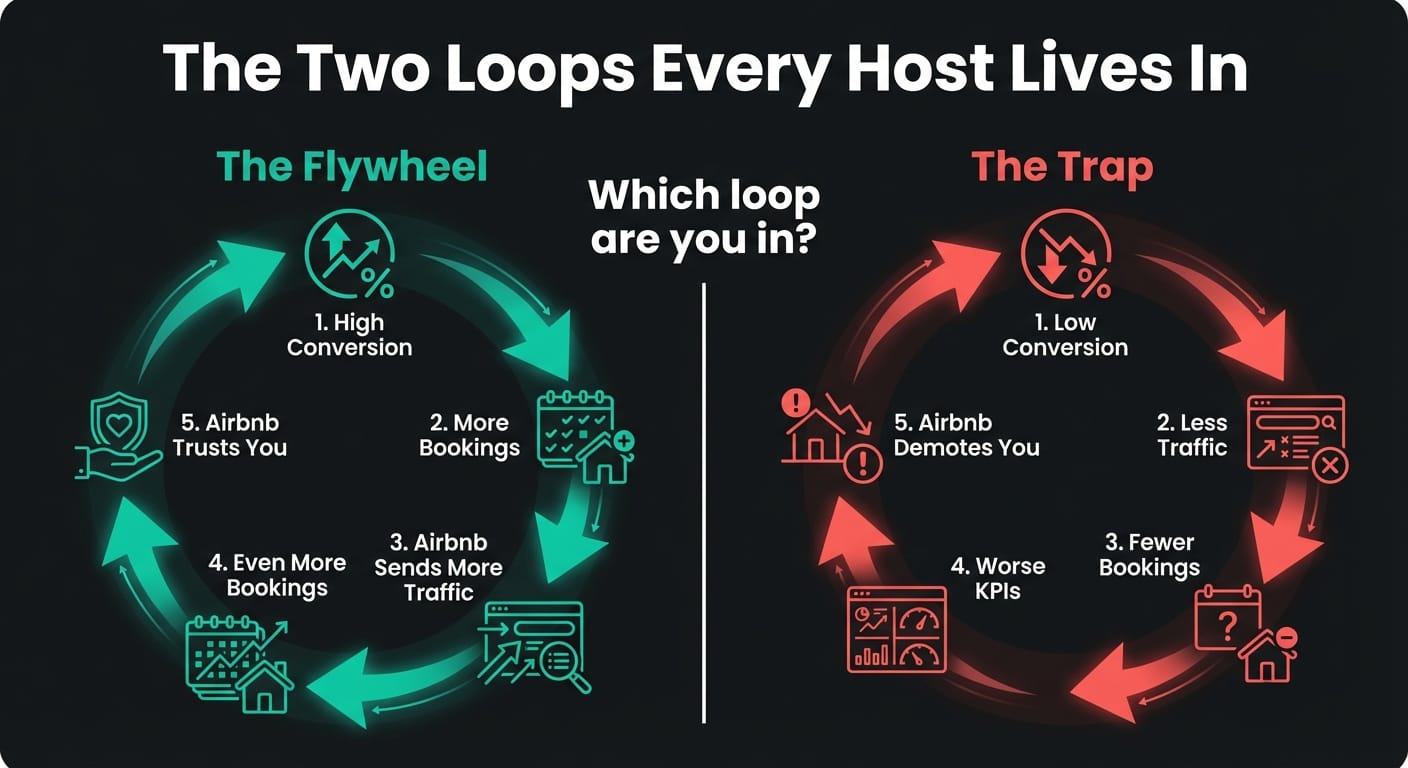
This is the part most hosts do not understand. Once you fall out of the top tier, you can get stuck in a negative feedback loop that compounds over time.
The negative loop works like this: less page-one exposure leads to less traffic, which leads to fewer bookings, which produces worse KPIs versus competitors, which causes Airbnb to devalue you and test you less often. Then it repeats.
Most markets behave like an 80/20 distribution: approximately 80% of bookings go to the top 20% of listings. If you are not in that top slice, it can feel like your listing is invisible.
The positive feedback loop is the inverse: you convert, you book, Airbnb sends more traffic, you book more, Airbnb trusts you more. The job is not to set a price. The job is to break into the positive feedback loop.
Why Filling Other Channels Can Starve Your Primary Booking Platform
Here is something that silently destroys listings and most hosts do not realize it.
If you fill up on other platforms and Airbnb cannot book your calendar, you reinforce the idea that Airbnb cannot monetize you. You might think you are being smart by diversifying. But if Airbnb is your primary demand engine, starving Airbnb can push you into the negative feedback loop because Airbnb sees less revenue potential from your listing.
This does not mean turn off other channels. It means balance them methodically so you do not sacrifice your primary booking channel while chasing short-term cash. That balance is part of ramping correctly.
One noteworthy finding from A/B testing on two mirror duplex units in San Diego: Airbnb does treat a blocked calendar differently from an empty calendar. Blocked calendars appear to receive more favorable treatment. Tests like this should be taken with a grain of salt for obvious reasons — length, sample size, and market variability — but the directional signal was consistent.
Why Airbnb Pricing Is a Signal, Not Just a Number
Here is the sentence that should reframe your entire approach: pricing is how you signal value to both a human and an algorithm.
If you price too high too early, you do not just lose a booking. You lose visibility. Because an unbooked listing is not making Airbnb money, and the platform does not reward that.
So pricing is not about maximizing nightly rate. Pricing is about maximizing the probability of booking at the highest possible rate without losing the algorithm's confidence. That distinction drives everything in this framework. As covered in our revenue optimization framework, the hosts who optimize for the flywheel — not the nightly rate — consistently outperform.
What Is Pricing Power and Why Does It Change Everything?
Pricing power is the single most important concept in Airbnb revenue management. It is earned, not assumed. You have pricing power when your listing is outperforming market occupancy. You do not have it when you are matching or trailing the market.
Here is why this matters. Consider two listings in the same market, both priced at $500/night:
| Metric | Listing A | Listing B | Market Average |
|---|---|---|---|
| Nightly Rate | $500 | $500 | $500 |
| Next-30-Day Occupancy | 70% | 40% | 50% |
| MPI (vs Market) | 1.40 | 0.80 | 1.00 |
| Has Pricing Power? | Yes | No | — |
Now both raise prices by $75/night. What happens?
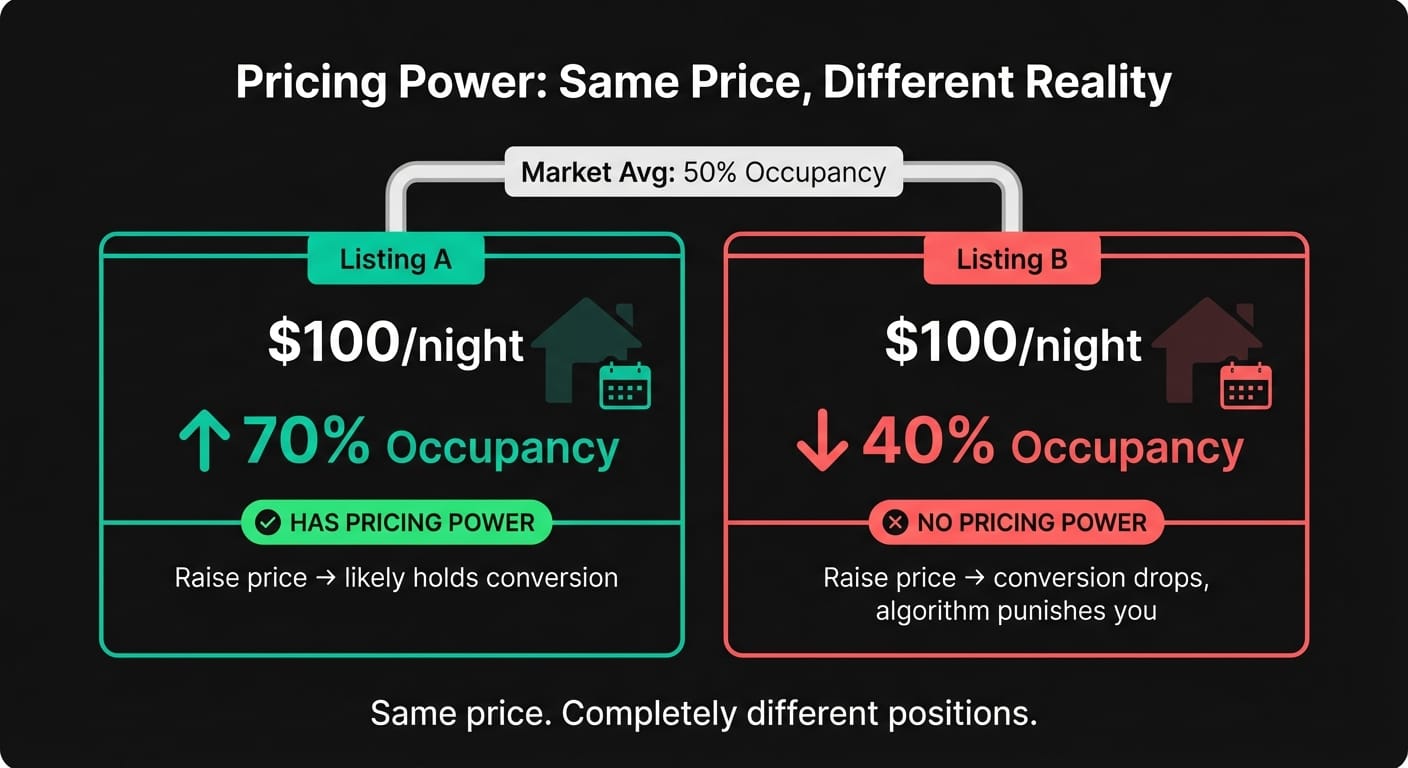
Listing A has pricing power. At $500, guests are choosing it at a rate that beats the market by 20 percentage points. Demand is proving the listing is undervalued. When Listing A raises price, Airbnb's signal is: this listing was converting above market, it moved price up, let us test it. Because demand was outpacing supply at $500, the listing likely holds conversion. Maybe occupancy drops from 70% to 63%. That is fine — you are still beating market, capturing more revenue per night, and maintaining the algorithm's confidence.
Listing B does not have pricing power. At $500, it is already below market occupancy. Guests are saying no more often than average. When Listing B raises price to $575, Airbnb's signal is: this listing was already underperforming, now it is more expensive, and bookings drop further. Airbnb de-promotes you. Less visibility, fewer eyeballs, weaker KPIs. The negative loop kicks in.
Same action. Completely different outcomes. The difference is pricing power.
The Amazon Analogy: Why You Cannot Spike Your Airbnb Price
Airbnb is not a hotel booking site. Airbnb is a search-and-rank marketplace. It functions more like Amazon than Marriott.com.
Consider this: you go to Amazon and search for a spatula. You expect Amazon to show you a well-reviewed, fairly priced spatula that matches what you are looking for. You trust that ranking. That trust is what makes Amazon's marketplace work — and Amazon protects it aggressively.
Now imagine a seller has a spatula listed at $12. It is selling well — good reviews, strong conversion, consistent sales velocity. Amazon starts showing it near the top. Then the seller changes the price to $24 overnight.
Amazon does not shrug and keep showing a $24 spatula at the top. Amazon knows a sudden price doubling changes the value proposition. Conversion rate tanks. Shoppers pick something else. Amazon re-ranks the product lower because it is no longer performing at the level that earned it the visibility.
Airbnb works the same way. When Airbnb shows your listing on page one, it is making an implicit promise to the guest: this listing is a good match at a fair price. When you spike your price dramatically, you break the signal that earned you the visibility. Airbnb tested you at $400 and you converted. Now you are at $550 and the algorithm tests you again — but you are a different value proposition. If guests stop saying yes, Airbnb stops giving you the spotlight.
You have to convince Airbnb to show you at the price you are trying to capture. You cannot demand it. You earn it incrementally by proving conversion at each step.
How the Pricing Ramp Works: A Step-by-Step Breakdown
Ramping is not abstract. It is a deliberate, step-by-step process of retraining Airbnb's model of what your listing is worth. Here is how it works mechanically.
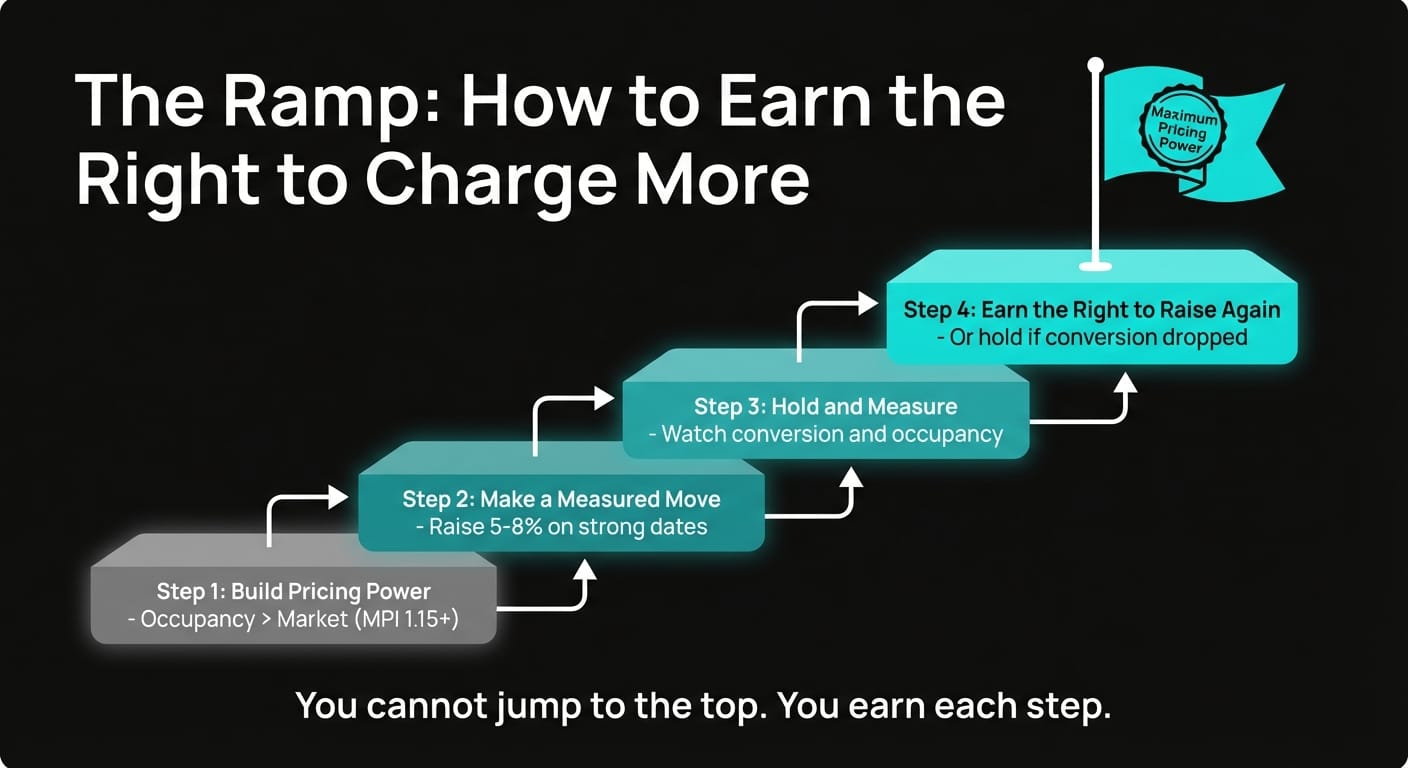
Step 1: Establish Pricing Power
Before you touch your rate, you need to outperform market occupancy. Target an MPI above 1.0 — ideally around 1.15-1.2 or higher depending on your market and goals. If you are at or below market, your job is not to raise price. Your job is to win bookings at your current rate until your occupancy proves you are undervalued. That might mean dropping price. It definitely means protecting conversion.
Step 2: Make a Measured Move
Once you have pricing power, raise price incrementally. Not 20%. A controlled increase — maybe 5-8% on specific date ranges where you are seeing the strongest demand.
Here is what happens behind the curtain: Airbnb sees the price change. Airbnb re-tests you. It gives you impressions at the new rate and watches. Do guests still click? Do they still book? If yes, Airbnb updates its internal model of your listing — your listing is now worth more in Airbnb's eyes. Your ranking holds or improves because you are still converting.
If conversion drops, Airbnb adjusts the other direction. You lose position. The ramp is a conversation with the algorithm. You are saying "I think I am worth more." Airbnb is saying "prove it."
Step 3: Hold, Measure, Repeat
After each increase, hold. Let the data come in. Watch your occupancy relative to market. Watch conversion. Watch your forward 30 days. If occupancy stays above market after the increase, you still have pricing power and can test another increment. If occupancy drops to market or below, you have found the ceiling for now. Hold there. Let performance stabilize. Rebuild if needed.
This is not a one-week project. It is a continuous cycle of asking: do I have pricing power right now? If yes, use it carefully. If no, protect what you have.
Step 4: Use Far-Out Dates to Manufacture Conversion
This is where pricing becomes a strategic weapon. If only a few guests are shopping far-out dates — say, 90+ days from now — and your listing is priced attractively for those dates, you can win a conversion with very few page views. That makes your conversion rate look exceptional because the denominator is small.
Once you secure the booking, jump the prices up for the remaining far-out inventory because you already captured the conversion signal Airbnb cares about. That is a very different approach than letting pricing software run automatically. It is using timing and demand windows to shape the signals Airbnb sees about your listing.
Why Demand Without Saturation Analysis Is Incomplete Pricing
Most dynamic pricing tools react to demand. What they often do not properly account for is saturation.
You can have a demand spike but still have a ton of remaining inventory in the market. If the market is not saturating on those dates, raising your prices just because demand nudged up can be an efficiency mistake.
When pricing any given date, three questions matter:
- Are people booking these dates? (booking velocity)
- How much inventory is left? (market saturation)
- If I raise price, will it cost me conversion and therefore cost me visibility?
That third question is everything. Demand-only pricing misses it entirely.
Understanding MPI in Practice
MPI stands for Market Penetration Index. It is your occupancy over a time period (like the next 30 days) divided by the market's occupancy over that same period. An MPI of 1.0 means you match the market. Above 1.0 means you are outperforming.
| MPI Range | What It Means | Action |
|---|---|---|
| Below 1.0 | Underperforming market | Reduce price, protect conversion |
| 1.0 - 1.3 | Matching or slightly above market | Hold and stabilize |
| 1.3 - 1.8 | Outperforming — ideal operating range | Measured price increases |
| Above 1.8 | Significantly underpriced | Increase prices to capture revenue |
For the listings under management, the goal is to exceed 1.8 MPI to establish pricing power, then increase prices until stabilizing at 1.3-1.8 depending on risk tolerance and market competitiveness.
What to Do When an Airbnb Listing Is Underperforming
If a listing is not performing, one of two problems usually exists:
- Trust problem: reviews, experience delivery, or operational issues.
- Value problem: the guest is not convinced at that price.
If trust is fine (4.8+ stars, clean reviews, no red flags), pricing becomes the fastest lever to fix value perception and conversion. Because again, Airbnb is watching conversion.
The goal is not cheap. The goal is a deal relative to what else exists. Your listing is never competing with your mortgage payment. Your listing is competing with the three listings above you in search that have similar photos, similar amenities, and similar reviews. Understanding this competitive frame is the foundation of effective listing optimization.
Common Airbnb Pricing Mistakes and What to Do Instead
Do Not Panic-Raise Prices at Market Occupancy
If you are sitting at market occupancy and you raise 20%, Airbnb may test you for a short window and then de-promote you when the bookings do not show up. You are spending pricing power you do not have.
Do Not Starve Your Primary Platform
Filling other platforms can backfire if it trains Airbnb that it cannot monetize you. Balance distribution methodically.
Do Not Game the Algorithm
Some hosts try to manufacture fake signals. The recommendation is simple: do not build your business on tactics that can violate platform rules or burn your account. Instead, manufacture real signals — real bookings, real conversions, real guest satisfaction. If you do that consistently, the machine eventually has to respect you.
Treat Every Price Increase as an Investment
Every time you raise price, you are spending credibility with the algorithm. If you raise and conversion holds, you earned it. If you raise and conversion drops, you paid a cost. Think of each price increase like an investment with downside risk if you have not earned the right to make it.
A Weekly Airbnb Pricing Workflow That Builds Momentum
Here is how to run pricing if you are managing one listing and want to build momentum. This is the practical version of everything covered above.
A) Protect the Two Pillars
Maintain review quality and guest experience so trust stays handled. Maintain conversion by staying competitive in your comp set.
B) Track What Airbnb Actually Cares About
| Metric | Timeframe | Why It Matters |
|---|---|---|
| Booking performance | Last 60 days | Recent performance drives current ranking |
| Conversion rate | Rolling | Views-to-bookings ratio signals value to algorithm |
| MPI (occupancy vs market) | Next 30 days | Determines whether you have pricing power |
| Forward calendar | Next 30 days | Near-term booking velocity shows monetization potential |
C) Make Changes Like an Operator, Not a Gambler
If you are only matching market occupancy, you do not have pricing power. Do not spike prices broadly. Your job is to earn it. If you are beating the market, you have pricing power. Test measured increases. Watch the response. Protect conversion at every step. Use far-out dates to capture conversion efficiently, then re-price once booked.
D) Remember What You Are Actually Optimizing
You are not optimizing nightly rate. You are optimizing the flywheel: conversion leads to bookings, which leads to visibility, which leads to more bookings, which earns you the right to charge more.
How to Convince the Airbnb Algorithm Your Listing Deserves Visibility
Most people think Airbnb SEO is photos, titles, and amenities. Those matter — but if you want the lever that moves the algorithm, it is pricing tied to performance.
Airbnb is deciding where you belong based on whether you are likely to make Airbnb money while protecting trust. Here is what nobody tells you: you cannot just pick the price you want and expect the platform to comply. You have to earn it. You have to prove it.
You have to convince Airbnb — through real conversion, real bookings, and real performance relative to your market — that your listing deserves to be shown at that rate. Just like a seller on Amazon cannot double the price of a spatula overnight and expect to hold their ranking, you cannot spike your Airbnb rate and expect to hold your visibility.
The hosts who win this game are not the ones who set the highest rate. They are the ones who understand that the rate is a conversation with the algorithm — and they know how to lead that conversation, one step at a time.
When pricing is done right, you are shaping conversion, occupancy, revenue, pricing power, and the platform's belief about your listing's value. And when you do that well, you stop begging for bookings. You start earning visibility.
Want to go deeper on a specific piece — how to run comps, think about minimum stays, or handle seasonal markets? Reach out and let us know what would be most useful.
Frequently Asked Questions
What is pricing power on Airbnb and how do you earn it?
Pricing power means your listing is outperforming market occupancy, measured by MPI (Market Penetration Index) above 1.0. You earn it by winning bookings at your current rate until occupancy proves demand exceeds supply. Only then can you raise prices incrementally without losing the algorithm's confidence or search visibility.
How does the Airbnb algorithm decide which listings appear on page one?
Airbnb treats page-one slots like prime real estate with opportunity cost. The algorithm prioritizes listings that maximize Airbnb's revenue while maintaining guest trust. Key signals include your 60-day booking performance, conversion rate versus competitors, market-relative occupancy (MPI), and forward booking velocity over the next 30-60 days.
What is MPI and what MPI should Airbnb hosts target?
MPI (Market Penetration Index) is your occupancy divided by market occupancy over the same period. An MPI of 1.0 means you match the market. Revenue managers typically target exceeding 1.8 MPI to establish pricing power, then increase prices until stabilizing at 1.3-1.8 depending on risk tolerance and market competitiveness.
Why does raising Airbnb prices too fast hurt your listing visibility?
Airbnb works like Amazon — it tests your listing at a specific price and watches conversion. If you spike prices and guests stop booking, Airbnb sees a bad investment and de-promotes you. Each price increase spends credibility with the algorithm. Proven approach: raise 5-8% incrementally, hold, measure conversion, and only increase again if occupancy stays above market.
What is the Airbnb negative feedback loop and how do you escape it?
The negative loop occurs when less page-one exposure leads to less traffic, fewer bookings, worse KPIs versus competitors, and further algorithmic de-promotion. Most markets follow an 80/20 distribution where top 20% of listings capture 80% of bookings. Escape by protecting conversion rate, pricing competitively to earn bookings, and building the positive flywheel of visibility.
Should Airbnb hosts fill bookings on other platforms like VRBO first?
Filling other platforms while starving Airbnb can silently destroy your listing. If Airbnb cannot book your calendar, it learns it cannot monetize you and reduces your visibility. A/B testing on mirror duplex units in San Diego showed Airbnb treats blocked calendars more favorably than empty ones. Balance channels methodically rather than chasing short-term cash elsewhere.
Sources & References
- Research on Airbnb ratings - Unknown
- Revenue optimization framework - OODA Management
- A/B testing on two mirror duplex units in San Diego - Author's testing
Related Articles

San Diego Airbnb Revenue – Proven 27% Optimization Framework 2025
Auto-pricing missing spikes? We lift San Diego Airbnb revenue 27% with analyst tuning, event intel, gap-day promos, and 40-50% direct bookings...

Dynamic Pricing for San Diego Airbnbs – Proven 20–35% Revenue Lift
Think dynamic pricing is enough? Software alone misses 40–60% of revenue. Our San Diego framework adds analyst reviews and direct bookings for 20–35% more...

San Diego Airbnb Listing Optimization – Proven 35% Booking Lift
Top 10% of listings snag 60%+ of views. San Diego Airbnb listing optimization lifts bookings 18–35% with the right hero photo and sequence—want the framework...
Ready to Maximize Your Revenue?
Join 500+ property owners earning 26% more with professional management. Get your free revenue analysis in 2 minutes.
Tell us how to reach you
We'll text you to book the next step.